Rhodochrosite and the Map of Intention: What a Crystal Grid Can and Cannot Do
Share
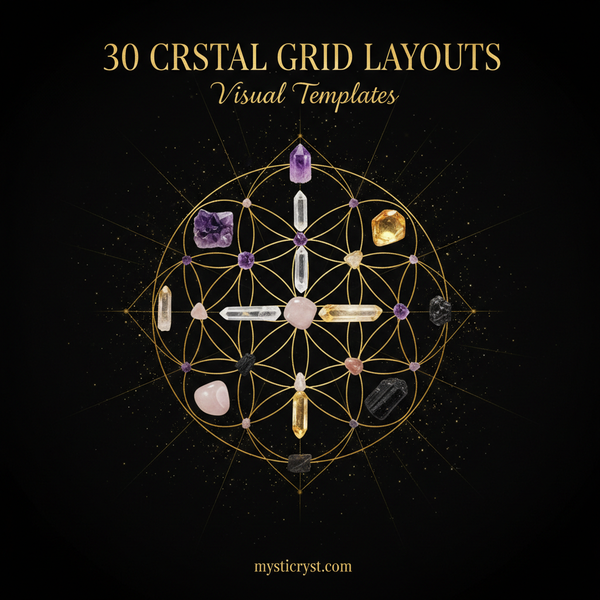
A crystal grid can feel like the most inviting thing in a metaphysical shop: a paper template, a ring of small stones, one larger centerpiece, and the promise that geometry will hold your intention steady. Rhodochrosite, with its banded rose and cream layers, often appears in these arrangements as a heart-centered anchor for love, compassion, or inner-child themes. But if you pause and ask what the grid is actually doing, the answer gets more interesting. Is the arrangement amplifying something? Is it simply a visual reminder? Or is the grid a way of slowing your own attention enough to clarify what you mean by the words you keep repeating?
The most honest and useful answer is that a rhodochrosite grid functions as a symbolic map of intention, not as a measurable energy device. The geometry does not scientifically amplify a mineral field, and no evidence shows that stones in a circle produce effects that stones in a line cannot. What the grid can do is externalize an inner commitment, give your attention a tactile and visual home, and turn an abstract value into something you can see every day. That is meaningful, but it is a different kind of meaning than the one usually advertised.
Why Rhodochrosite Carries the Heart Theme
Rhodochrosite is a manganese carbonate mineral, typically forming in banded masses or rhombohedral crystals. Its color ranges from pale pink to deep raspberry, sometimes with white or gray swirls. In gemology, it is relatively soft and often cut for collectors or beads rather than for hard-wearing jewelry. That physical softness is worth noting because it shapes how the stone is used: a polished cabochon or tumbled piece is more common in reflective practice than a faceted ring.
Its modern symbolic association with the heart is not ancient and universal. It is a contemporary metaphysical convention, built largely from color symbolism. Pink and rose tones in modern crystal culture are repeatedly linked with affection, gentleness, self-compassion, and emotional openness. Rhodochrosite's banding adds a second layer: many practitioners read the swirls as a reminder that feelings are not neat categories, that tenderness and difficulty can sit in the same stone. This is poetic interpretation, not mineralogy. The manganese content does not deliver an emotional effect, and touching the stone does not release a nutrient or a mood-altering substance.
Some writers connect rhodochrosite with the heart chakra, while others place it with the solar plexus because of its warm color or with the root because of its formation in manganese deposits. These assignments vary by author, lineage, and era. That variation is normal. Modern seven-chakra color systems are themselves relatively recent and were not a single fixed ancient doctrine. If a source links rhodochrosite to the heart and another to the solar plexus, neither is making a scientific claim. They are using different symbolic grammars.
What a Grid Adds to the Symbolism
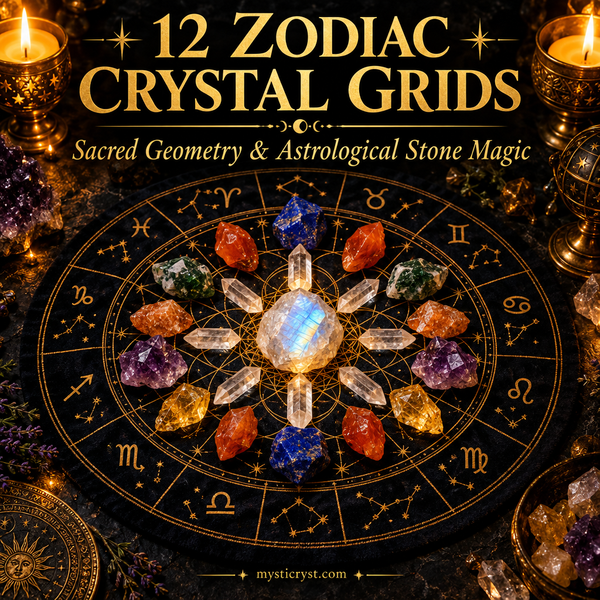
A crystal grid is a modern ritual arrangement. It is sometimes given ancient pedigree, but the elaborate geometric placement of stones with printed templates is largely a contemporary practice. Sacred geometry carries real meaning in mathematics, art, architecture, and religious symbolism, but that does not mean a circle of rhodochrosite creates a measurable healing field. Geometry can organize attention. It cannot be shown to amplify a metaphysical force.
That distinction is not a dismissal. It is a clarification of what the grid is for. A grid offers three practical functions:
- Structure: it gives a ritual a beginning, a middle, and an end, which helps attention stay oriented.
- Symbolic mapping: the center stone can represent the core value, while surrounding stones represent supporting themes or daily actions.
- Visual reminder: a grid left on a desk or altar becomes an environmental cue, a quiet object that prompts a repeated intention.
None of these require a supernatural mechanism. They are features of how people use objects, space, and repetition to shape behavior and reflection.
The Center and the Ring
If you are building a rhodochrosite grid as a reflective practice, the most important symbolic decision is what each position means. A common approach is to place one rhodochrosite piece at the center as the core intention, then place supporting stones around it that represent specific, observable actions. This turns the grid from a wish map into a plan.
For example, a grid centered on self-compassion might have rhodochrosite in the middle, and surrounding stones labeled for rest, honest conversation, boundary-setting, and asking for help. The rhodochrosite does not make those actions happen. It marks the theme they serve. The stones are reminders. The behavior is the practice.
Color Symbolism Without Universal Claims
Rhodochrosite's color is often read through modern Western color associations: pink as care, red-pink as vitality and courage, cream as gentleness. These associations are cultural and personal, not fixed laws. In other contexts, pink may carry very different meanings. Treating color symbolism as a universal language flattens real cultural differences and overstates what color psychology can support.
What you can reasonably do is notice your own associations. Does the banding remind you of a specific relationship? Does the color feel warm, or does it feel cloying? Personal resonance is real as an experience, even when it is not evidence of an intrinsic property. If rhodochrosite feels meaningful to you, that meaning can be used. If it does not, that is not a spiritual failure. It may simply be the wrong symbolic tool for the intention you are working with.
Translating Intention Into Observable Action
The clearest way to keep a rhodochrosite grid honest is to pair each symbolic position with a behavior. A grid that never connects to daily life becomes decoration with a vocabulary. A grid that translates into action becomes a reflective structure.
Consider a simple three-part arrangement:
- Center: rhodochrosite, standing for the intention to practice self-compassion.
- Left marker: one stone representing a boundary you will actually state this week.
- Right marker: one stone representing a moment of rest you will actually schedule.
Each time you pass the grid, you do not need to visualize energy. You can simply ask whether the boundary was stated and whether the rest was taken. This is not a lesser practice. It is the part that gives the symbolism traction.
Common Misunderstandings and Conflicting Correspondence Systems
Several ideas about grids and rhodochrosite deserve gentle correction. The first is that more stones or more complex geometry make a grid stronger. There is no evidence for that. Complexity can make a grid harder to maintain and easier to abandon. Simplicity often serves attention better.
The second is that a grid must be cleansed of negative energy or recharged under a full moon to work. Cleansing and charging are optional ritual conventions, not physical necessities. Rhodochrosite is soft and can be damaged by salt, prolonged water soaking, heat, or abrasion. If you want a low-contact symbolic method, a dry brush, a brief intention, or simply placing the stone back on its cloth is safer for the material than saltwater or sunlight.
The third is that a rhodochrosite grid can attract love, restore a relationship, or change another person's feelings. It cannot. Love-related symbolism is better used for themes such as self-respect, openness, reciprocity, communication, and grief. Consent and mutual behavior matter more than any arrangement of stones.
A Reflective Exercise for One Week
If you already own a rhodochrosite piece, you do not need a full grid to begin. Try this seven-day reflection. Place the stone somewhere you will see it once each morning. Write one sentence about what you want to treat with more tenderness: a decision, a relationship, a memory, or a habit of self-criticism. At the end of the day, write one sentence about what actually happened. Did you speak to yourself the way you would speak to a friend? Did you avoid a conversation, or enter it? The stone is a cue. The journal is the record.
If you want to add a grid structure, let the center be the theme and the surrounding stones be the actions. Keep it small enough that you will maintain it. A grid of five stones you actually use will do more for your reflective life than a grid of thirty that becomes clutter.
What the Grid Can and Cannot Promise
A rhodochrosite grid can hold a theme, organize a ritual, mark a commitment, and remind you of a value you have chosen. It can be beautiful, and beauty matters. It cannot guarantee emotional healing, attract a specific person, replace therapy, or produce a measurable energetic effect. The gemstone is a mineral with a particular color, composition, and softness. The grid is a modern symbolic practice. The meaning comes from you, from your attention, and from what you do after the stones are placed.
That is not a diminished version of the practice. It is the version that can be used with integrity, whether you approach it as a spiritual ritual, a reflective habit, or simply a quiet object that helps you remember what you are trying to become.